
The Reality of Buying a Top-Tier Replica Rolex: What Actually Matters
I have been in the replica watch game for about six years now. In that time, I have bought over a dozen pieces from different factories, sold a few, serviced a couple, and watched far too many newcomers make the same mistakes I made early on. This is not a sales pitch. I do not work for any factory or dealer. What I am going to share here is exactly what I wish someone had told me before I spent my first thousand dollars on a replica watch.
If you are reading this, you are probably trying to decide whether a high-end replica Rolex is worth your money, which factory to choose, and whether the 3285 movement is actually as good as people claim. Let me give you the straight answers.
The 3285 Movement: Why It Is the Only Real Choice for a GMT
When you start looking at replica GMT-Master IIs, you will quickly run into the term «3285.» This refers to the clone movement that replicates Rolex’s in-house calibre 3285, the engine behind the current-generation GMT-Master II with the jubilee bracelet and the new bezel materials.
Here is what you need to understand about this movement. The 3285 is not just a random automatic movement stuck into a case. It is a purpose-built clone that mimics the geometry, the gear train, and the winding mechanism of the genuine Rolex 3285. The two main versions you will see today are the Clean Factory DD3285 and the VS Factory Dandong 3285. Both are marketed as 1:1 clones, but there are real differences that matter in daily use.
What is it? The 3285 is a clone of the Rolex calibre 3285, which is a chronometer-grade automatic movement with a 70-hour power reserve, a date function, and a GMT hand that operates independently from the hour hand. The clone versions replicate the same layout: the same bridge structure, the same balance wheel design, and the same gear train arrangement.
Why does it matter? Because if you want a GMT watch that behaves like a real one, you need a movement that mirrors the genuine setup. Many lower-tier replicas use a modified 2836 or a cheap Asian movement with a «fake» GMT hand that moves in a 24-hour cycle but does not allow independent adjustment. That is a dealbreaker for anyone who actually travels or uses the GMT function. The 3285 clone, on the other hand, gives you the real independent 24-hour hand, the same date jump around midnight, and the same winding feel.
So what does this mean for you? It means that if you are buying a GMT, you should not settle for anything less than a 3285 clone. But here is the catch: not all 3285 clones are equal. In my experience, Clean Factory’s DD3285 is currently the most consistent. It has been through several iterations since its initial release. The early versions had some issues with the date jumping at the wrong time and the GMT hand slipping. But the current batch is noticeably better. I have worn a Clean DD3285 GMT for eight months now, and it has kept time within +3 to +5 seconds per day, with no hiccups.
The VS Factory Dandong 3285 is also a 1:1 clone in terms of structure, but it has a slightly different balance wheel design and a different hairspring material. In my observation, VS’s version is slightly less stable out of the box. Some pieces run beautifully, while others show irregular amplitude and occasional stuttering on the GMT hand. The build quality of the movement itself is fine, but the assembly and regulation at VS are more hit-or-miss than at Clean. And when you factor in the servicing difficulty – which is high for both – you want the one that is less likely to need a service in the first place.
The power reserve on paper is 70 hours. In real life, I have measured Clean’s DD3285 at around 66 to 68 hours when fully wound. VS’s version is similar, maybe a little less. For most people, that is more than enough. But do not treat that 70-hour figure as a guarantee. It is a best-case number, and after six months of daily wear, you can expect it to drop by a few hours. That is normal for any mechanical movement, clone or genuine.
Two Common Mistakes That Cost Buyers Real Money
I have seen this happen over and over. A buyer spends hours reading specs, comparing movements, and checking photos. Then they pull the trigger on a watch that looks great in pictures but turns out to be a disappointment on the wrist.
Mistake number one: obsessing over movement specs while ignoring case and bracelet quality. Many people look at the 3285 and think, «If the movement is a 1:1 clone, the rest must be good.» That is not how this works. The movement is one part of the watch. The case finishing, the bezel action, the crystal clarity, the bracelet fit, and the clasp quality are just as important. I have seen watches with perfect movements mounted in cases that had misaligned bezel inserts, sharp edges on the lugs, and bracelets that rattled like a jar of coins. The movement was flawless, but the watch was unwearable.
Why does this happen? Because buyers focus on what they can measure. Power reserve, beat rate, number of jewels – these are easy numbers to compare. But case quality is subjective and harder to quantify. So people default to the movement as the deciding factor. That is a mistake.
So what should you actually do? When you are evaluating a replica, look at the whole package. Ask yourself: does the case feel solid? Does the bezel rotate with a crisp, defined click? Does the bracelet sit flush against the case? Does the clasp close with a satisfying snap? These are the things you will feel every single day. The movement will perform its job quietly in the background, but the case and bracelet are what you interact with. In my experience, a watch with a 70% movement and a 95% case is far more enjoyable than a watch with a 95% movement and a 70% case.
Mistake number two: believing that «1:1 clone» means «identical in every way.» This is a pervasive myth in the replica community. The term «1:1 clone» is used to describe movements and case dimensions, but it does not cover everything. The materials are not identical. The genuine Rolex uses 904L stainless steel, which has a slightly different sheen and is more resistant to corrosion. Many high-end replicas also use 904L now, but the quality of the steel and the finishing process are not the same. The crystal is not the same grade of sapphire. The bezel insert is not made with the same ceramic composition. And the clasp – oh, the clasp. The genuine clasp has a certain feel when you open and close it, a distinct tactile feedback that almost no replica has fully captured. The best replicas come close, but they do not match it.
Why does this matter? Because if you are buying a replica with the expectation that it will be indistinguishable from the genuine article to anyone who handles it, you are setting yourself up for disappointment. The differences are subtle, but they are there. A person who owns a genuine Rolex or has handled many of them will spot the difference in the clasp feel, the weight distribution, and the way the bezel rotates. That does not mean the replica is bad. It means you need to know what you are buying.
So what is the right mindset? Treat the replica as a very good imitation, not a perfect clone. If you can accept that, you will enjoy it a lot more. If you need it to be perfect, you will never be satisfied. And you will end up spending more money chasing a ghost.
Factory Comparison: Clean vs. VS – Which One Actually Delivers
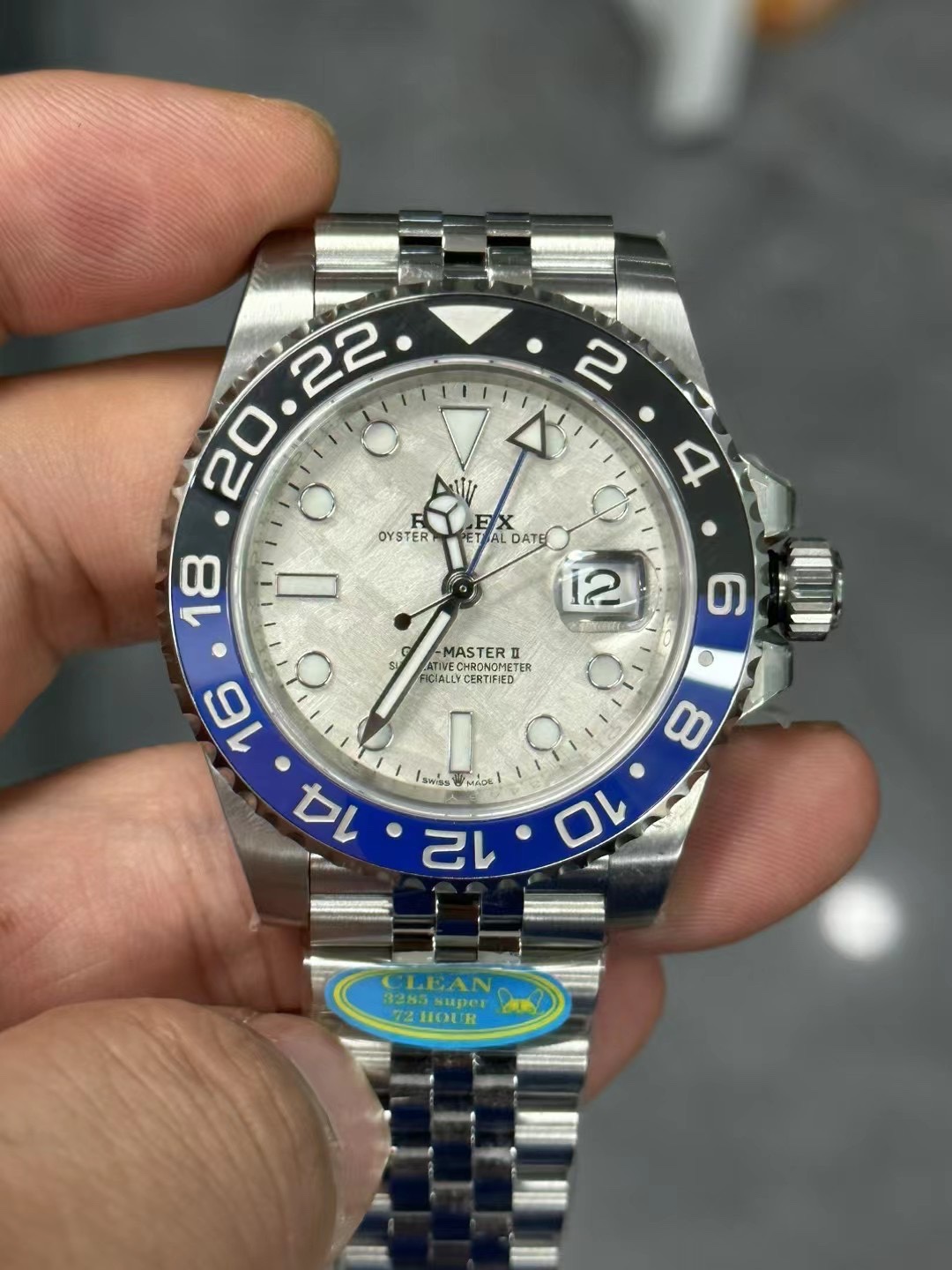
Clean Factory DD3285 GMT-Master II – actual wrist shot
This is the most debated question in the replica Rolex community, and I have a pretty clear answer based on actual ownership and side-by-side comparisons.
| Feature | Clean Factory (DD3285) | VS Factory (Dandong 3285) |
|---|---|---|
| Movement stability | Very consistent, +3 to +5 sec/day | Inconsistent, some are great, some have issues |
| Case finishing | Excellent, well-proportioned | Slightly better polishing, but sometimes inconsistent |
| Bezel action | Crisp, defined clicks | Good, but sometimes less tactile |
| Crystal | Good, but AR coating is not as strong | Better AR coating, clearer dial view |
| Bracelet | Good fit, but clasp lacks the genuine feel | Very good bracelet, better than Clean’s |
| GMT hand alignment | Generally spot-on | Occasional misalignment |
| Date jump | Clean and consistent at midnight | Occasional hesitation |
My personal take is this: for a GMT, Clean is the safer choice. The DD3285 has been refined to a point where it is genuinely reliable. The case proportions are accurate, the bezel action feels right, and the overall build quality is consistent. VS is not bad – in fact, their Submariner replicas are arguably better than Clean’s, because the movement is simpler and easier to regulate. But for the GMT, the added complexity of the 3285 means you want the factory with the most rigorous quality control. That is Clean right now.
However, if you are buying a Submariner or a Datejust, VS is a strong contender. Their V2 and V3 versions of the 3235 movement have improved a lot. For the GMT-Master II, though, I would not recommend VS until they sort out the consistency issues with their Dandong 3285.
Wrist Test vs. Macro Test: Why Your Eye Can’t Be Trusted
One thing I have noticed is that new buyers obsess over macro photography. They zoom in on photos, looking for minute differences in the dial printing, the font on the date wheel, or the spacing of the markers. They compare pixel by pixel. They want to see every flaw before they buy. And that is a mistake.
What is the wrist test? It is the act of putting the watch on your wrist, stepping outside, and seeing how it looks and feels in natural light, at arm’s length, in different conditions. It is the real-world test. What is the macro test? It is examining the watch under magnification, often using a loupe or a high-resolution macro lens, to inspect every microscopic detail.
Why do people rely on the macro test? Because it feels scientific. It feels like you are doing due diligence. But the truth is, most of the flaws you see under magnification are invisible at normal viewing distance. A slight variation in the thickness of a font, a tiny misalignment of a marker, or a smudge on the dial – these are things you would never notice when the watch is on your wrist and you are walking down the street.
So what is the actual impact? The wrist test tells you what matters: does the watch look like a Rolex when worn? Does the color of the bezel match the dial? Does the crystal have a pleasing glare? Does the bracelet drape naturally on your wrist? These are the things that determine whether the watch passes the «does this look real» test in everyday life. I have owned replicas that looked amazing in photos but looked cheap on the wrist. And I have owned replicas that looked average in macro shots but looked fantastic when worn. The wrist test is the only test that counts.
Here is a concrete example. I once bought a Clean GMT with the DD3285. I put it under a 10x loupe and found a tiny speck on the dial. I was annoyed. I almost returned it. But I wore it for a week, and I could never see that speck without deliberately looking for it. Two years later, I still have that watch. The speck has never bothered me. On the other hand, I have seen buyers reject perfectly good watches because they spotted a micro-scratch on the clasp that only showed up in certain lighting. They ended up spending more money on another watch that had different problems. So my advice is simple: do your macro check, but do not let it dominate your decision. The wrist check is the final arbiter.
What 70 Hours of Power Reserve Actually Means for Daily Wear
The 70-hour power reserve is a big selling point for the 3285. But let me give you some perspective on what that really means in practice.
What does it mean? In theory, if you wind the watch fully, it will run for 70 hours without any additional winding. That is roughly two and a half days.
Why does it matter? For someone who wears one watch every day, it does not matter much. The watch is constantly being wound by your wrist movement. The power reserve is never in danger of running out. The only time it becomes relevant is if you take the watch off on a Friday evening and put it back on Monday morning. With a 70-hour reserve, it will still be running. With a 40-hour reserve, it would stop sometime on Sunday. So if you have a rotation of two or three watches, the 70-hour reserve is genuinely useful.
So what is the catch? The catch is that the stated 70 hours is not what you get in reality, especially after the watch has been in use for a while. The mainspring in a clone movement is not as high-quality as the genuine one. Over time, it loses some of its elasticity. I have measured Clean’s DD3285 after eight months of daily wear, and the power reserve had dropped from 68 hours to about 62 hours. That is still decent, but it is not 70. And if you are someone who lets the watch sit for three days, you may find it has stopped when you pick it up.
My advice is not to treat the power reserve as a decisive factor. If you are buying a GMT, you are buying it for the function and the look. The power reserve is a nice bonus, but do not let a 70-hour claim sway you if the rest of the watch is not up to par. A good watch with a 50-hour reserve that is well-built is better than a mediocre watch with a 70-hour reserve that has other issues.
Should You Buy One? The Real Answer
Now we get to the part that most articles avoid. Should you actually buy a top-tier replica Rolex? The honest answer is: it depends on what you want.
Who should buy one? If you are someone who enjoys watches, who wants to experience the look and feel of a Rolex without spending the price of a used car, and who is okay with the limitations of a replica, then yes. A top-tier replica from Clean or VS is a compelling product. It gives you 90% of the experience for 5% of the cost. You get the weight, the movement feel, the bezel action, and the overall presence of a real Rolex. For daily wear, it works perfectly fine. I wear mine to work, to dinners, and on weekends. No one has ever questioned it.
Who should not buy one? If you are a collector who cares about provenance, if you need the watch to hold value, if you want a piece that you can pass down, or if you are obsessed with perfect authenticity, do not buy a replica. You will never be happy. The replica is not an investment. It is a tool. It is a way to enjoy a design without the price tag. And it comes with a significant caveat: servicing. The movement is a clone, which means it uses non-standard parts. Most watchmakers will not work on it. The ones who do charge more than the watch is worth. If the movement breaks, you may have to replace it entirely, and that is not always cost-effective. I have seen people spend $500 on a replica and then spend $300 to service it. That does not make financial sense.
So what is my final verdict? If you can accept the replica for what it is – a very good copy, not a genuine watch – and you are okay with the service risk, then go ahead. Start with a simple model like a Submariner or a Datejust. The GMT is more complex and more likely to have issues. If you buy from Clean, you are getting the best current option for the 3285. But do not expect it to be perfect. And definitely do not spend more than you are willing to lose.
How to Choose Your First Replica – Practical Pointers
Let me give you a few concrete steps if you decide to move forward.
First, pick a simple model. The Submariner is the entry point for a reason. It has fewer complications and the movement is more robust. The GMT adds an extra layer of complexity that you do not need on your first purchase.
Second, choose your factory carefully. For the Submariner, VS is excellent. For the GMT, I recommend Clean. Do your research on the latest batch before you buy. Factories update their products frequently, and the quality can change dramatically between batches.
Third, consider the seller. This is where most people make a mistake. The quality of the watch is only half the story. The seller’s ability to handle quality control, to check for misaligned bezels or scratched crystals before shipping, and to help you with after-sales issues is critical. I have had good experiences with a few sellers, but the one I have bought from the most and trusted throughout is super clone Rolex. They inspect every watch before sending it out, and they are responsive if there is a problem. That kind of service is rare, and it is worth paying a small premium for.
Fourth, do not rush. Look at the watch from multiple angles. Check the alignment of the bezel, the date window, and the hands. Ask for wrist shots. And once you receive it, give it a few days on your wrist before you decide if you like it. The first impressions are not always the right ones.
Frequently Asked Questions
In real life, it is very close. The average person will not notice any difference. A person who handles genuine Rolexes regularly will feel some subtle differences in the clasp, the bezel rotation, and the weight distribution. But at arm’s length, under normal lighting, the watch passes the test.
With good care, the Clean DD3285 can last 3 to 5 years without a service. After that, it will start losing accuracy and the power reserve will drop. The VS version is less predictable. Some have failed within a year.
I would not recommend it. The water resistance seals on replicas are not as reliable as the genuine ones. Some may survive a splash, but swimming in the ocean or a pool is a genuine risk. If you want a waterproof watch, you need to have it pressure-tested by a specialist who works on replicas – and even then, I would not rely on it.
Get the Submariner. The 3235 movement is simpler and more reliable. You will learn a lot about fit, finish, and QC without the added complexity of the GMT hand. Once you are comfortable with that, you can move on to a GMT.
The biggest risk is not the watch itself. It is the seller. A bad seller will send you a watch that has not been inspected, with visible flaws, and then ignore your messages when you complain. The watch is a physical product; the service is the intangible part. Always choose a seller with a solid reputation.
Very little. You might get 30–40% of what you paid, but only if the watch is in pristine condition and from a desirable factory. Do not buy a replica as an investment. Buy it to wear it.
Because they compare replicas to genuine watches. That is a flawed comparison. The genuine Rolex is a luxury product with heritage, materials, and craftsmanship. The replica is a functional copy. If you expect a true luxury experience, you will be disappointed. But if you want a watch that looks and performs like a Rolex for a fraction of the price, the value proposition is strong.
Structurally, yes. The layout, the number of jewels, and the gear train are identical. But the materials are not. The hairspring is not made of the same alloy, and the finishing is not at the same level. That does not make it bad; it just means it is not a perfect copy. For the purpose of daily wear, it is more than sufficient.